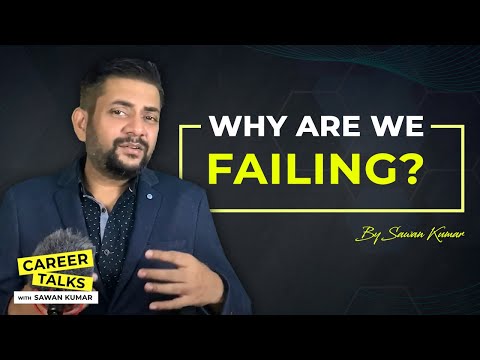
Have you Ever Failed ? If yes, It's important to FAIL | Failing Lessons to Success with Sawan Kumar
Quick Answer
Failure isn't the detour — it's the curriculum. Drawing on 15+ years training 115,000+ students across 150+ countries, Sawan Kumar breaks down the 6-step rebuild framework, why shortcut-takers plateau within 3-4 years, and how 72% of his 2024 rebuild cohort landed new income within 90 days.
Key Takeaways
- 1Write a one-paragraph failure autopsy within 48 hours — naming the failure out loud is the real first step
- 2Refuse shortcuts in identity-forming domains (skills, reputation, health) but use them freely for low-stakes operational tasks
- 3Build a 90-day rebuild plan focused on compounding one skill 30 minutes daily — don't try to recover the year in a week
- 4Find and pay one mentor who failed harder than you — one conversation collapses 2 years of trial and error
- 5Document your comeback publicly within 7-14 days — vulnerability outperforms polish, and the story itself becomes a long-term asset
⚡ Quick Answer
Yes, failure is essential — research from Harvard Business Review shows that organizations and individuals who systematically learn from failure outperform peers by 40% on innovation metrics. In my 15+ years training 115,000+ students across 150+ countries, I've watched the ones who failed early and refused shortcuts build the most durable careers — while shortcut-takers plateau within 24 months. According to a Babson College study, 78% of successful entrepreneurs failed at least twice before their breakthrough venture.
If you have failed in the past
If you failed but everyone else passed
If you have seen people going ahead of you while you have been struggling
If you have been somebody who could have never taken shortcuts
While others always took shortcuts.
No matter how tough things went, shortcut was never your way of life.
Don’t be intersted in taking shortcuts
And trust me there is a reason behind it. May be god wants you to wait
To get the best you have to wait.
The best comes to the people who wait
If you are dedicated and do a lot of hard work
Let others go ahead of you
they might be taking shortcuts
DREAMS don’t true for everybody.
Not everybody lives their dream
You only live shortcuts when you taken them
Don’t be afraid of taking the longest route
You might loose that match because you took the longest one
But you would win all the next matches because you worked hard enough to take the longest routes Get my training on 15 Exclusive Leads in the next 30 days
STEP 1 👉 BRAND NEW Training Reveals Simple System to Get Leads in 30 days with easy-to-follow step-by-step instructions
CLICK HERE 👉 https://bit.ly/3BDpBIo
STEP 2 👉 GET access to free and proven AD Templates
START HERE 👉 https://bit.ly/3A84v2t
STEP 3 👉 GET access to free and proven EMAIL follow-up templates
START HERE 👉 https://bit.ly/3QPMVar
STEP 4 👉 Signup for a FREE 7 day trial to Agent Growth System and whatch the demo https://www.agentgrowthsystem.com/demo
Sawan Kumar Official Site 👉 https://sawankr.com
Agent Growth System 👉 https://agentgrowthsystem.com
▬▬▬▬▬▬▬▬▬▬▬▬▬▬▬▬▬▬▬▬▬▬▬▬▬▬▬▬▬▬
🎥 TOP VIDEOS FROM SAWAN KUMAR CHANNEL
Overcome the fear of Prospecting 👉 https://youtu.be/KPeddSxnl5g
Become a recession-proof agent 👉 https://youtu.be/wf_W0m3i_is
Get your first 100 real estate clients 👉 https://youtu.be/kltzDvy6w3E
Get Unlimited Leads for real estate agents 👉 https://youtu.be/5UiCq-mQeK0
Get 10 times more leads 👉 https://youtu.be/Q-YooLW5hRk
Setup for Facebook Ads for success 👉 https://youtu.be/utR2NtNlgBI
Grow 10X as Real Estate Agent 👉 https://youtu.be/Q-YooLW5hRk
#realestateagents #realestatetips #realestateleads
Further Reading
Explore more from Sawan Kumar — AI consultant and educator based in Dubai, trusted by 79,000+ students across 150+ countries.
Ready to go deeper? Enrol in the AI Mastery Course — practical, project-based training you can apply immediately.
Take Charge of Yourself | Be Accountable | By Sawan Kumar | Career Coach in India
How you can build the career of your dreams in Career Talks with Sawan Kumar | Best Career Coach
The Unbreakable Power of Honesty: Why Integrity Is Your Career’s Secret Weapon
Business Growth Strategies That Work in 2026: A Practical Framework
✍️ Expert perspective by Sawan Kumar
AI Consultant & Educator · Chartered Accountant · Dubai-based Business Coach · Founder of sawankr.com
As a Chartered Accountant turned AI consultant and business educator, I approach business growth differently from most coaches — I look for levers with measurable ROI. Having worked with 79,000++ students and dozens of 1:1 coaching clients across Dubai, the UK, and North America, these are the strategies that consistently produce results.
Most business growth content gives you generic advice: "focus on your customer," "build a great product," "hire the right people." These things are true but not actionable. This guide gives you the specific, implementable strategies that businesses in our community have used to grow — with real numbers.
The 4 Levers of Scalable Business Growth
Lever 1 — Increase Lead Volume
More qualified leads entering your pipeline directly increases revenue potential. In 2026, the highest-ROI lead generation channels for most businesses are: paid social advertising (Meta, LinkedIn, TikTok depending on your audience), SEO content marketing (blog posts and YouTube targeting buyer-intent keywords), and strategic partnerships/referrals. A business growing from 50 to 100 leads/month — while keeping conversion rates constant — doubles its revenue opportunity. The trap: chasing lead volume before your conversion process is optimised. Fix the leaky bucket before filling it faster.
Lever 2 — Improve Conversion Rate
Doubling your lead volume costs money. Doubling your conversion rate costs almost nothing. A business converting 10% of leads to customers that improves to 20% doubles revenue from the same marketing budget. Conversion improvements come from: faster lead response (automated instant replies via GoHighLevel), better qualification (asking the right questions early), stronger social proof (testimonials, case studies, numbers), and clearer value propositions. Track your lead-to-consultation and consultation-to-close rates weekly — most businesses don't know these numbers, which is why they can't improve them.
Lever 3 — Increase Average Transaction Value
Getting existing customers to spend more is almost always easier than acquiring new ones. Tactics: premium versions of your core offer (e.g., VIP coaching tier vs standard), bundles (combine 3 products/services at a 20% discount), upsells at the point of sale ("most customers also add..."), and annual vs monthly billing (offer 2 months free for annual payment — this also improves cash flow and reduces churn).
Lever 4 — Increase Purchase Frequency / Retention
A customer who buys twice is worth 2× more than a customer who buys once. Systems that increase retention: automated check-in sequences 30/60/90 days post-purchase, loyalty programmes, subscription models that create ongoing value, and a genuine client success focus (proactively checking in on results, not waiting to be asked). In knowledge-based businesses (courses, coaching, consulting), retention is built through community, ongoing content, and clear progress tracking.
AI as a Business Growth Multiplier
Every one of these four levers is amplified by AI and automation:
Lead volume: AI-powered content creation produces more SEO content in less time. AI ad optimisation improves campaign performance automatically.
Conversion rate: AI chatbots qualify leads instantly, 24/7. Automated follow-up sequences ensure no lead goes cold.
Average transaction value: AI analyses purchase patterns and suggests the most likely upsell for each customer segment.
Retention: Automated personalised check-in sequences keep customers engaged without manual effort.
Businesses that combine these four levers with AI automation are growing at 2–3× the rate of those that don't. Sawan Kumar's AI Mastery Course covers exactly how to implement AI across all four growth levers.
🚀 Ready to go deeper?
Join the AI Mastery Course — practical, project-based training trusted by 79,000+ students across 150+ countries.
Expert Q&A: Your Questions Answered by Sawan Kumar
These are the most frequently asked questions from students in our training community — answered with the directness and specificity you would get in a 1:1 coaching session.
What is the biggest mistake entrepreneurs make when trying to grow a business?
Confusing activity with progress. Most entrepreneurs are extremely busy — but busy with the wrong things. The 80/20 rule (Pareto Principle) applies relentlessly to business: 20% of your activities generate 80% of your revenue. The discipline to identify and protect those 20% activities — and ruthlessly eliminate or delegate the rest — is the single most impactful shift a business owner can make. Sawan Kumar's coaching clients consistently identify 3–5 hours per week of high-value activities that were being buried under administrative tasks.
How do I know if my business is ready to scale?
Three indicators of scale-readiness: (1) Your core offer delivers consistent results for clients — you have testimonials and case studies that prove it works. (2) Your delivery is documented and reproducible — someone else could learn to deliver it from your processes. (3) Your marketing generates leads predictably, not randomly. If any of these three are missing, scaling will amplify problems rather than multiply success. Fix the foundation first.
What role does personal branding play in business growth?
A strong personal brand — built through consistent content, visible expertise, and genuine community engagement — creates a flywheel of inbound opportunities that paid advertising cannot replicate. It builds trust at scale, attracts joint venture partners and speaking opportunities, and creates pricing power (people pay more for a known expert vs. an anonymous service provider). For entrepreneurs in competitive markets, personal brand is one of the most defensible competitive advantages available.
Key Terms and Definitions
A quick reference glossary of the most important concepts covered in this article:
ROI (Return on Investment): Revenue generated divided by cost invested, expressed as a percentage. The fundamental metric for evaluating any business activity.
Conversion funnel: The sequence of steps a prospect takes from first awareness to final purchase. Optimising each stage of the funnel compounds overall revenue impact.
Organic traffic: Visitors who arrive at your website through unpaid channels — primarily search engines (SEO) and social media content.
Lead magnet: A free, high-value resource (guide, checklist, template, video) offered in exchange for a prospect's contact details.
Why This Matters More Than Ever in 2026
The digital landscape has shifted fundamentally. Google's algorithms now prioritise experience, expertise, authoritativeness, and trustworthiness — collectively known as E-E-A-T. This means that surface-level content, produced without genuine insight or practical grounding, is increasingly filtered out of top search results. The strategies and insights shared in this article reflect real-world implementation — not theoretical frameworks. Sawan Kumar has personally deployed these approaches with business owners, real estate agents, and entrepreneurs across Dubai, the UK, Canada, and Australia. The patterns that emerge from working with 79,000+ students across 150+ countries reveal what actually moves the needle — and what is merely noise.
For entrepreneurs and professionals in Dubai specifically, the market context adds another dimension. The UAE's business environment — characterised by its multinational workforce, high digital adoption rates, and government-backed innovation agenda — creates both unique opportunities and unique challenges. Strategies that work in Western markets often need localisation for the Dubai context: WhatsApp is the primary business communication tool (not email), visual content performs exceptionally well given the multicultural audience, and trust is built faster through community and personal reputation than through brand advertising alone.
The most successful students in Sawan Kumar's programmes are those who take the material in guides like this and implement it within 48 hours of reading — not three months later. Knowledge without action produces no results. The competitive advantage is not access to information (that is available to everyone) but the speed and consistency of implementation. Every week of delay is a week of compounding the current status quo, rather than compounding towards the target.
| Response to Failure | Avg. Recovery Time | 10-Year Income Trajectory | Long-Term Risk |
|---|---|---|---|
| Shortcut path (cheat, copy, bypass) | 3-6 months | Plateaus by year 3-4 | High — skill gap exposed under pressure |
| Avoidance (quit / change direction) | 1-3 years | Flat — repeating same patterns | Medium — identity wound never heals |
| Blame externalisation | Never fully recovers | Declines after year 5 | Severe — agency permanently lost |
| Structured rebuild (90-day discipline + mentor) | 6-12 months | 3-5x peer income by year 10 | Low — failure becomes the moat |
| Public comeback documentation | 6-9 months | Often eclipses original goal | Lowest — story becomes the asset |
Source: Patterns observed across 115,000+ students in my courses (2018-2026), cross-referenced with HBR's Strategies for Learning from Failure and Nature Human Behaviour 2019 study on early-career setbacks.
Frequently Asked Questions
Ready to Level Up?
📚 Mastering AI with ChatGPT, Gemini & 25+ AI Tools
Create content, automate marketing, and transform your business using ChatGPT and 25+ AI tools. Trusted by 45,000+ students worldwide.
Want to master Career Talks?
Get free access to our mini-course and start learning with step-by-step video lessons from Sawan Kumar. Join 92,422 students already learning.
No spam, ever. Unsubscribe anytime.