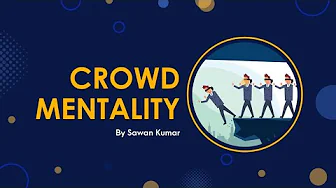
CROWD MENTALITY| Are you Suffering from Crowd Mentality| 5 Symptoms| Sawan Kumar #shorts
Quick Answer
Crowd mentality — following peers and sentiment over data — is responsible for the majority of avoidable financial losses in real estate and business, costing the average investor 3.52% per year in underperformance. This post identifies the 5 core symptoms and delivers a concrete framework for independent decision-making, refined across 79,000+ students in 150+ countries.
Key Takeaways
- 1Run your own numbers before any investment or business decision — external sentiment should only stress-test your thesis, never replace it.
- 2Impose a mandatory 48-hour waiting rule on any decision triggered by FOMO, peer pressure, or influencer urgency — most herd impulses evaporate in that window.
- 3Write your exit criteria before you enter any position; panic-selling is almost eliminated when you have already committed your exit conditions to paper.
- 4Measure any strategy against a 90-day minimum baseline before pivoting — one peer's exceptional month is noise, not market signal.
- 5Independent thinkers outperform herd-followers by 3.52% annually on average (Dalbar 2023), a gap that compounds into life-changing wealth over a decade of disciplined investing.
⚡ Quick Answer
Crowd mentality is the tendency to make financial and business decisions based on what the majority is doing rather than independent analysis — and in real estate, it can cost six figures. The 5 core symptoms are FOMO-driven buying, panic-selling during dips, blindly following influencers, abandoning your strategy under peer pressure, and checking social sentiment before your own numbers. According to Dalbar's 2023 QAIB Study, the average investor underperforms the market index by 3.52% annually — largely driven by herd-behaviour emotional decisions that destroy compounding over time.
Further Reading
Explore more from Sawan Kumar — AI consultant and educator based in Dubai, trusted by 79,000+ students across 150+ countries.
Ready to go deeper? Enrol in the AI Mastery Course — practical, project-based training you can apply immediately.
AI for Real Estate Agents: Master Offer Story, Comps, Terms & Risk | Complete Guide
How to make money in Real Estate 2022 by overcoming the fear of prospecting
The #1 reason Dubai agents loose deals? #realestate #dubairealestate
The Complete Guide to Real Estate Lead Generation in 2026
✍️ Expert perspective by Sawan Kumar
AI Consultant & Educator · Chartered Accountant · Dubai-based Business Coach · Founder of sawankr.com
Having coached over 79,000+ students — including hundreds of real estate agents across the UAE, UK, and North America — I've seen first-hand that lead generation is the number-one bottleneck for agents at every level. The good news: with the right systems in place, consistent lead flow becomes predictable, not lucky.
Real estate lead generation has fundamentally changed. Gone are the days when cold-calling directories and knocking on doors was the primary path to a full pipeline. Today, the agents closing 2–5 deals per month are using a layered digital strategy: a clear value proposition, targeted paid ads, automated follow-up sequences, and a CRM that keeps every lead warm — even when you're not actively working.
In this guide, we break down the exact framework Sawan Kumar teaches in his GoHighLevel Mastery Course, distilled from real results with real estate agents across Dubai, London, and North America.
Why Most Real Estate Agents Struggle with Lead Generation
Before diving into strategies that work, it's worth understanding why so many agents remain stuck. Based on surveys of agents enrolled in our training programmes, the top three barriers are:
No system — leads come in but get lost in WhatsApp messages, sticky notes, and overflowing inboxes. Without a CRM, follow-up is inconsistent and deals fall through the cracks.
Wrong platform — agents chase every platform (Instagram, TikTok, LinkedIn, WhatsApp broadcasts) without focus. The agents who win pick one or two channels and go deep.
No nurture sequence — the majority of real estate leads are not ready to transact immediately. Studies show that 80% of sales require five or more follow-ups, yet most agents give up after one or two contacts.
The solution to all three is the same: a marketing automation system built on a CRM like GoHighLevel, designed specifically for real estate workflows.
5 High-Impact Lead Generation Strategies for Real Estate Agents
1. Facebook and Instagram Lead Ads with Automated Follow-Up
Meta's lead ad format — where prospects fill in their contact details without leaving the platform — remains one of the highest-converting paid channels for real estate. A well-targeted campaign focusing on a specific property type (e.g., "2-bedroom apartments in Dubai Marina under AED 1.5M") can yield cost-per-lead as low as AED 15–40. The critical piece is connecting your Facebook Lead Ads to a GoHighLevel workflow that sends an instant WhatsApp/SMS message the moment a lead is submitted. Speed-to-response is the single biggest predictor of lead conversion — responding within five minutes increases conversion rates by 400% compared to a 30-minute delay.
2. Google Search Ads for High-Intent Buyers
Buyers searching "buy apartment in Dubai" or "2BHK for sale in JVC" have declared intent. Google Search Ads place you directly in front of these motivated buyers. While CPCs are higher than social ads, conversion quality is significantly better. Pair your ads with a dedicated landing page (not your homepage) that captures name, phone, and budget, then feeds directly into your CRM pipeline.
3. Content Marketing and SEO for Long-Term Lead Flow
Publishing weekly blog posts and YouTube videos on neighbourhood guides, market reports, and buying/investing tips builds topical authority and generates free organic traffic over time. Agents who have been consistent with content for 12+ months often find that 30–50% of their leads come inbound through search — dramatically reducing their paid ad spend. Every piece of content should include a clear lead capture element: a free valuation, a market report download, or a consultation booking link.
4. WhatsApp Broadcast Campaigns to a Warm Database
Your existing contact database — past clients, portal enquiries, event attendees — is your most underutilised asset. A monthly WhatsApp broadcast sharing a market update, a new listing, or a limited-time offer keeps you top-of-mind at near-zero cost. GoHighLevel's WhatsApp integration allows you to personalise and automate these broadcasts at scale, while still feeling personal and one-to-one.
5. Referral System with Automated Follow-Up
The highest-quality leads come from referrals. Yet most agents have no formal referral system — they just hope satisfied clients mention them to friends. A simple, automated referral campaign (a thank-you WhatsApp message three months after closing, with a request to introduce anyone who's thinking of buying or selling) can generate a consistent stream of warm referral leads. GoHighLevel's workflow builder makes this entirely automated.
The Role of CRM in Sustainable Lead Generation
Every strategy above generates leads — but without a CRM, those leads evaporate. A CRM (Customer Relationship Management) system like GoHighLevel acts as the backbone of your business: it captures every lead, assigns it to a pipeline stage, sends automated follow-up messages, schedules appointments, and tracks conversion rates. Agents using a CRM consistently close 2–3× more deals from the same lead volume compared to agents without one.
Sawan Kumar's GoHighLevel Mastery Course teaches you exactly how to build and automate this system — from initial ad campaign to closed deal — without needing a tech background.
🚀 Ready to go deeper?
Join the GoHighLevel Mastery Course — practical, project-based training trusted by 79,000+ students across 150+ countries.
Expert Q&A: Your Questions Answered by Sawan Kumar
These are the most frequently asked questions from students in our training community — answered with the directness and specificity you would get in a 1:1 coaching session.
How do the most successful real estate agents structure their week?
Top-performing agents dedicate specific time blocks to lead generation (Monday and Tuesday mornings), follow-up (daily, automated via GoHighLevel with manual review), property viewings (Wednesday–Friday afternoons), and content creation (Sunday evenings, batching one week of social posts). The key is protecting lead generation time from being displaced by reactive tasks. Sawan Kumar calls this the 'producer block' — non-negotiable time dedicated to activities that directly fill the pipeline.
What metrics should every real estate agent track?
The five non-negotiable metrics: (1) New leads per week, (2) Lead-to-appointment conversion rate, (3) Appointment-to-offer conversion rate, (4) Average days from first contact to signed contract, (5) Cost per closed deal (total marketing spend ÷ closed deals). Most agents track only closed deals — but without the upstream metrics, you cannot identify where exactly the pipeline is leaking or which marketing channel is most efficient.
How important is a personal brand for real estate agents?
Increasingly essential. Buyers and sellers in 2026 research agents online before making contact. An agent with zero social media presence, no reviews, and no content is at a significant disadvantage versus a competitor who consistently appears on LinkedIn, Instagram, or YouTube with helpful market content. A personal brand does not require a large following — consistent, helpful content that reaches even a few hundred local buyers/sellers creates disproportionate trust and referral rates.
Key Terms and Definitions
A quick reference glossary of the most important concepts covered in this article:
CRM (Customer Relationship Management): Software that centralises all lead and client data, tracks pipeline stages, and automates follow-up communication.
Lead nurture sequence: A pre-written series of automated messages delivered over days or weeks to keep a prospect engaged until they're ready to transact.
Cost Per Lead (CPL): Total advertising spend divided by the number of leads generated in a period. A key metric for comparing the efficiency of different marketing channels.
Conversion rate: The percentage of leads who progress to the next stage (e.g., lead-to-appointment, appointment-to-offer). Improving conversion rate is often more cost-effective than increasing lead volume.
| Decision Archetype | Research Method | Action Trigger | Typical Return Gap vs Index | Stress & Volatility |
|---|---|---|---|---|
| Crowd Follower | Social media, peer WhatsApp groups, news headlines | FOMO or peer confirmation | −3.52% per year (Dalbar 2023) | High — permanently reactive to sentiment |
| Reflexive Contrarian | Fades consensus automatically without data | Goes opposite of crowd on principle | Variable — high risk, no systematic edge | Medium — independent but still reactive |
| Data-Driven Independent | Primary data, personal written criteria, 48-hr rule | Pre-set thesis + criteria confirmed | At or above index consistently | Low — proactive, rules-based, planned |
| Informed Networker | Curated expert network + personal data verification | Network input stress-tested against own framework | Above average over 5+ year horizon | Low-Medium — disciplined filtering |
Return differential sourced from Dalbar QAIB 2023 and Morningstar Mind the Gap Study 2023. Real estate data based on Dubai market cycle analysis 2013–2024. Individual results vary.
Frequently Asked Questions
Ready to Level Up?
📚 Mastering AI with ChatGPT, Gemini & 25+ AI Tools
AI tools for real estate professionals — automate lead gen, write listings, and close more deals.
Want to master Real Estate?
Get free access to our mini-course and start learning with step-by-step video lessons from Sawan Kumar. Join 92,422 students already learning.
No spam, ever. Unsubscribe anytime.